
Seven principles for safer trauma processing
Written by Brandon Zahl Bloom
Considering trauma therapy can easily bring up concerns. What if the feelings become too much? What if you leave the session struggling to get through the rest of your day? Will things get worse?
These concerns deserve a place in the work from the beginning. In my approach to trauma therapy, we pay attention to what you need before, during, and after processing. The seven principles below guide how we prepare, choose a starting point, and adjust as we go. Collectively, they help make trauma work more manageable while supporting your ability to stay on track with daily life.
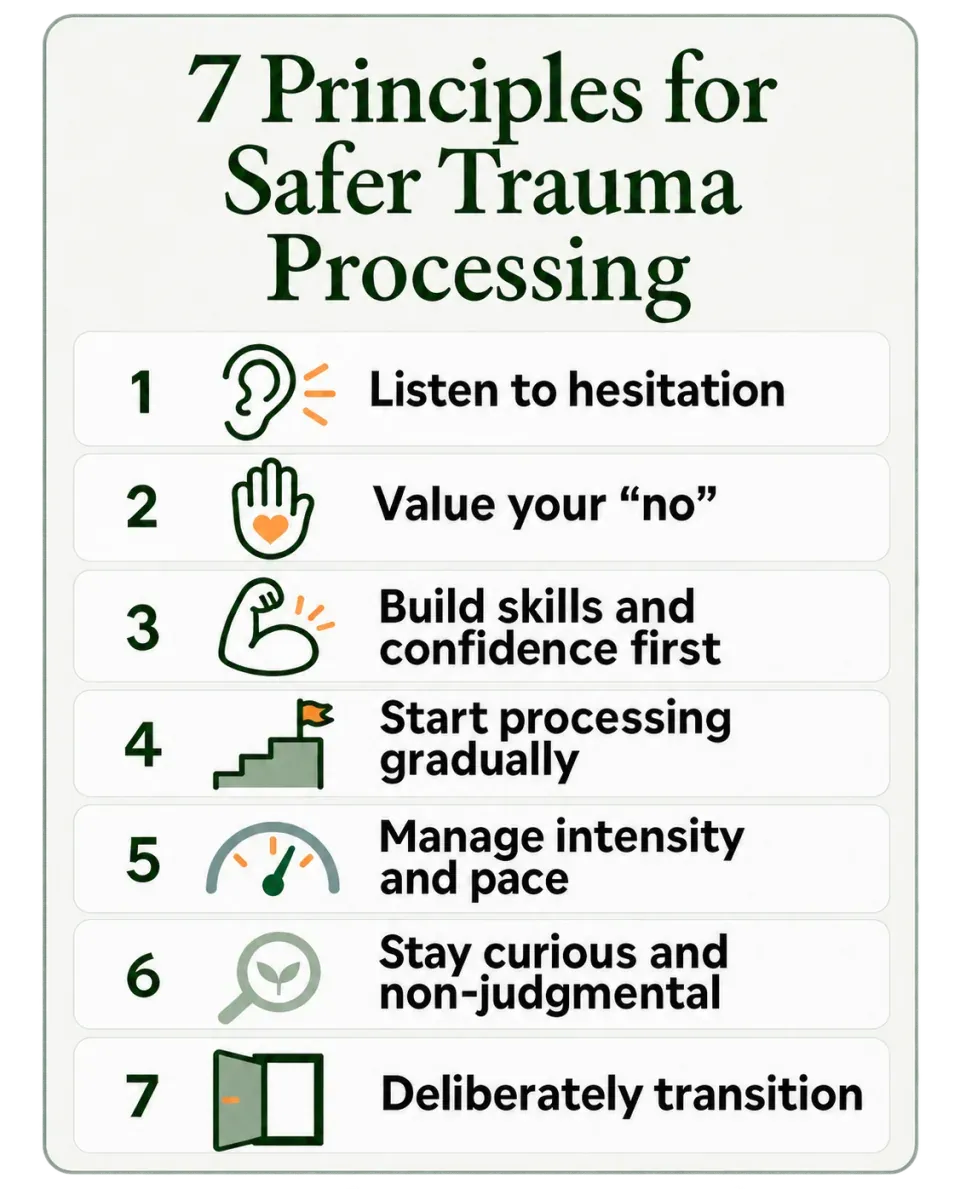
The principles, summarized
- Listen to hesitation: Bring your concerns and fears into the process so we can use those to inform our work.
- Value your “no”: Your feedback matters if something doesn’t feel right.
- Build skills and confidence first: Build proficiency with helping your nervous system recenter.
- Start processing gradually: Tackle the easier pieces first to experience success and build from there.
- Manage intensity and pace: Go slow and help your nervous system stay within its limits.
- Stay curious and non-judgmental: Relax expectations and notice what unfolds.
- Deliberately transition: Find what helps you shift from therapy back into your life.
Safety principle #1: Listen to hesitation
Hesitation can tell us something useful about what you need. One part of you may want to begin, while another worries about losing control, feeling exposed, or being disappointed again.
I want to include these concerns respectfully, without treating them as fears you just need to get over. When we push past hesitation, we can miss important information. Exploring the hesitation gives us a fuller picture which helps us come up with a better plan. You don’t have to feel completely confident before taking a step, but you also don’t have to silence the part of you that is not so sure.
Safety principle #2: Value your “no”
There’s a power dynamic in the therapy relationship that can be very harmful - “The therapist knows best and a good client just follows their lead without question.” If either the therapist or client acts this out, therapy has an increased risk of causing harm.
The antidote to this is humility and respect. I might have solid training and experience but there’s a lot I don’t know about what is best for you. I respect your inner wisdom on what feels right or not.
When it comes to trauma processing, I can’t know what you feel ready for and what you don’t. I can’t know if touching on a subject immediately brings up strong feelings of fear and apprehension. I don’t know if this is something you’d just rather not talk about right now. Your No is so helpful for me as I aim to support you.
Saying no is difficult for many people, especially in unequal power dynamics, and we’ll work together to help this feel like a positive, safe option.
Safety principle #3: Build skills and confidence first
Building skills first helps address a big concern that many clients have about therapy – getting overwhelmed. Skills help you gain clarity on how much intensity you’re feeling in the present moment and guide yourself back to center when it starts to feel like too much.
Perhaps you already have some solid skills you use to help you ground or find calm again - but most people want to build more here. I approach skill building from a body-first perspective - we are looking for whatever helps support your nervous system’s natural ability to manage intensity. This is different from other more cognitively-focused skills, like thinking positive thoughts. In my experience it tends to be more effective and confidence inspiring.
There’s a wide range of possibilities and I will help guide you to explore options in a non-pressured way. We take an experimental mindset and don’t treat anything that doesn’t work as some type of problem. If something doesn’t work, it’s simply helpful information that your nervous system needs another type of support. I trust we will find something that helps.
Safety principle #4: Start processing gradually
For many clients trauma feels like a big black hole of stuff that they’ve pushed down for their whole lives. So when they imagine processing, they see themselves jumping into that hole or getting swallowed by it. That would be overwhelming for anybody and thankfully it is not like that.
I have many ways of helping you start gradually, with just a small slice and only once you feel ready. The right sized slice varies per person and I can help you gauge that. It could be something like just sitting for a bit with what comes up when you think about trauma therapy, without even going into any of the stories. The goal is to take on something that feels doable and that you’ll have a high likelihood of success with. It may be small but we keep building on that success to make this process feel a whole lot less intimidating.
Safety principle #5: Manage intensity and pace
Your nervous system has a certain capacity for intensity and us trauma therapists refer to this as your Window of Tolerance. Staying within this window while you process difficult experiences will help prevent your nervous system from getting overwhelmed and that it’ll be able to use its natural processing ability to help resolve the issue.
Every nervous system shows signs telling us whether it is inside the window or outside it. Before we start processing, I work with clients to help them better read their own signs. Some signs of being near the edge of your window are feeling floaty or panicky. Signs of being outside it are blanking out or becoming suddenly tired.
While we process, we go slowly enough so that both you and I can track how your nervous system responds to what is being brought up. Most often this is slower than you would normally think or tell the story. If needed, we bring in a nervous system regulation skill or pause to come back to the present. Leaving the window of tolerance does happen from time to time for clients and having my guidance can help it feel a lot more manageable and short-lived.
Safety principle #6: Stay curious and non-judgmental
While processing, it’s not always clear what is going to come up or where the process is going to go. It’s important to have a space that feels curious, non-judgmental and free of expectation. Everything that comes up during processing has a good reason to be there and deserves respect. Rarely does the process go exactly as we expected but frequently it seems to take you right where you needed to go.
Familiar judgments may show up, too: “I should be over this,” “I’m doing it wrong,” or “I’m making too big of a deal about this.” You don’t have to make those thoughts disappear. We can step back and get curious about them just as we would any other response. There is no wrong way to think or feel in therapy.
Paradoxically, when we stop trying to change ourselves we are actually the most open to change. Curiosity, care, respect and non-judgement are the soil in which organic healing and growth happens.
Safety principle #7: Deliberately transition
The transition from therapy back into your daily life matters and it’s important to explore what works for you. As a starting place, here are a couple ideas we can discuss:
The first is exploring what helps you set aside difficult material after a session so you can return your attention to daily life. The EMDR Container technique can be helpful here – it essentially is a guided visualization where you put any material you’d like into a visualized container, secure it and put it away for safekeeping until next time. We can leave time at the end of a session to walk through this.
If things pop back up during the week, you can use the EMDR container technique on your own, helping remind your brain that it does not need to spend any more time on this right now. If needed, I have several different tools we can try here too and I’m happy to help between sessions.
The second is considering the space and support you should give yourself afterwards. Like a good workout, processing can leave you feeling a bit drained and tender. Time for resting, cuddling, taking a walk or another self-care activity can help you recharge and feel ready to re-enter the flow of your life. Perhaps there are trusted people you can talk with or get care from.
Interested in what working together might look like?
If you’re curious about possibly starting some trauma therapy, I’d be happy to chat. Reach out for a free, no-obligation 25-minute video consultation.