
Online EMDR Therapy in Seattle & Washington
Accepting new clients
You want to heal from the past or break a stubborn pattern but know that talk therapy may not be the right fit. EMDR therapy offers an effective, research-backed method of processing trauma and distressing memories in a different way than traditional approaches. By tapping into your brain and body’s innate processing abilities you can feel better naturally - without needing to open everything back up again.
Online EMDR offers the same tools as in-person EMDR while giving you the flexibility to fit therapy into your life. Services are available in Seattle and throughout Washington. Request a free, no pressure 25-minute consultation to explore how EMDR could help.
Reviewed by Brandon Zahl Bloom, Licensed Mental Health Counselor
It’s possible to both want change and to be hesitant about diving into it
You know change is overdue. You may feel on guard in a place you know is safe, struggle to relax with someone you know you can trust, or carry conversations with you long after they end. Perhaps you’re more reactive than you want to be, caught between how you hoped to respond and what actually happens.
Yet, approaching the work brings up uncertainty. Will therapy actually work this time? What if I don’t know what from my past is causing this? Will I become overwhelmed or just dig a lot of stuff up only to leave it unresolved again?
EMDR may offer some answers to those questions and a path forward.

EMDR offers new possibilities
EMDR offers a structured, bite-sized way to work with distressing memories and their associated beliefs, emotions, and body sensations.1 Its aim is to reduce the distress connected with those experiences using the natural processing abilities of the brain and nervous system, while avoiding overwhelm.
EMDR therapy differs from traditional talk therapy by targeting the brain’s deeper processing systems instead of just verbal discussion. While talk therapy engages the logical brain, it often misses the emotional and neurological patterns where trauma is stored in the nervous system. This can leave people feeling stuck in a place where they understand what is happening and why but are unable to move past it.
EMDR supports healing from trauma, PTSD, anxiety, depression and other distressing experiences. Unlike traditional talk therapy, EMDR does not require you to relive or discuss the traumatic event in detail. Instead, it uses bilateral stimulation, such as side-to-side eye movements, to help your subconscious mind do the heavy lifting. EMDR helps when traditional talk therapy is not enough.
How does EMDR work?
EMDR, known more fully as Eye Movement Desensitization and Reprocessing therapy, is officially divided into 8 phases.1 To make a simpler explanation here - it essentially breaks down into three basic parts:

Preparation
Gathering relevant details and a list of distressing memories to reprocess. Additionally, we’ll make sure you feel equipped with calming skills to use if needed later on during processing. I often help clients build body-based tools that actually work.
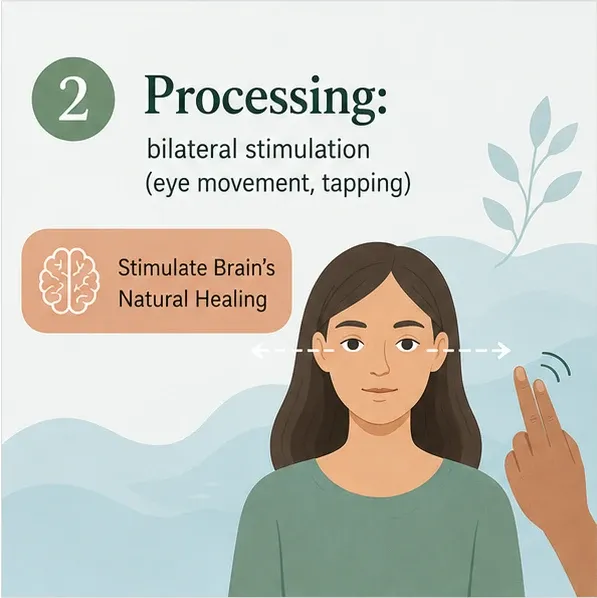
Processing
You’ll recall a mental snapshot of a memory and then follow me as I engage you in bilateral stimulation (a term that just means engaging both halves of your brain). The most common way is following my finger as it moves side to side. We’ll repeat this in short rounds of 30-90 seconds and watch the natural healing process unfold.
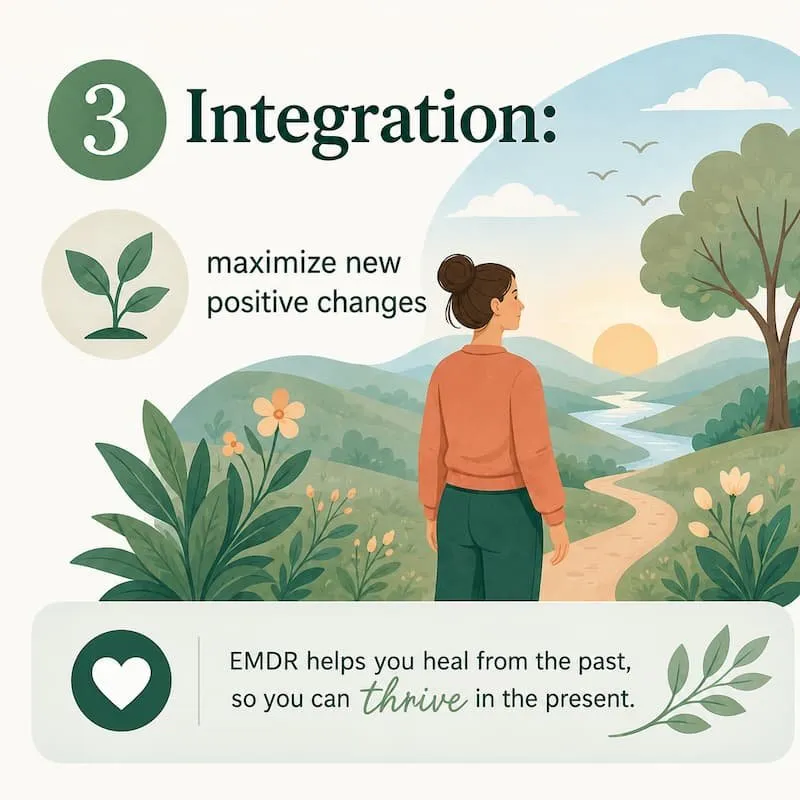
Integration
Once processing is complete, you’ll feel much less upset and have a new positive belief that replaces the negative belief created by the memory. Integration helps you strengthen this belief and resolve any blockers to fully believing it.

EMDR is an evidence-based treatment
Research on EMDR is still emerging but already demonstrates efficacy for some major mental health concerns, with the strongest evidence for PTSD.
- For PTSD, a review of 65 clinical trials found that EMDR reduced PTSD symptoms and that improvements continued after treatment ended. It also helped reduce anxiety and depression that accompanied PTSD.2
- For anxiety, a research review found that EMDR reduced symptoms, mainly in people who also had PTSD. More research is needed on anxiety without PTSD.3
- For depression, a review of eight clinical trials found promising improvements, but the evidence is still limited.4
- For complex PTSD (CPTSD), research is encouraging but less developed. A review of treatments for CPTSD symptoms found that EMDR helped with PTSD symptoms and some relationship difficulties in people with complex-trauma features. Evidence was more limited for managing emotions and improving self-worth, and not everyone studied had a formal CPTSD diagnosis.5
Issues that EMDR may help with
EMDR therapy helps address a wide range of mental health issues because it targets the underlying root causes rather than just the symptoms. By facilitating the brain’s natural processing of traumatic memories and distressing experiences, EMDR can reduce the emotional intensity and negative beliefs associated with these events. This deep-level work allows clients to experience lasting relief and improved functioning across many areas of life.
EMDR is used for treating:
- Post-Traumatic Stress Disorder (PTSD)
- Anxiety disorders
- Depression
- Complex trauma
- Panic attacks
- Phobias
- Complicated grief
- Negative self-talk and self-doubt
- Chronic pain
- Relationship difficulties related to past trauma
Clinical trials and research reviews support EMDR as a treatment for PTSD; the evidence does not establish equal effectiveness for every concern listed here.6
Because EMDR works on the root causes stored in the nervous system and brain, it can help clients achieve healing that goes beyond traditional talk therapy approaches.
Does doing EMDR online make sense for you?
Online therapy comes with a lot of convenience and saves you the hassle of getting to an in-person appointment. You won’t need to plan around traffic, transit connections, or finding parking. That can make a difference when fitting care around life in Seattle and make it feel a whole lot more doable. However, feeling comfortable with the setting matters just as much as the convenience. You can read more about how online therapy works with me.
Here's some common concerns about doing EMDR online:
Can EMDR happen through a screen?
The techniques of EMDR can be delivered through telehealth, including guided eye movements or self-tapping. You don’t need to be in-person with me to engage your brain and body’s natural ability to process difficult experiences.
Will I feel supported without someone in the room?
My preparation work focuses on building a supportive connection, recognizing the early signs that could build to overwhelm and ensuring you have ways to help recenter if needed. When we go into processing, I help you take a bite-sized approach rather than bringing up too much at once.
What if home doesn’t feel like a therapy space?
Some of my clients meet from their car or from another space outside their home. Sometimes putting a fan or white noise machine outside your door gives you enough privacy to join from home. We can discuss this concern more and brainstorm solutions in a consultation.
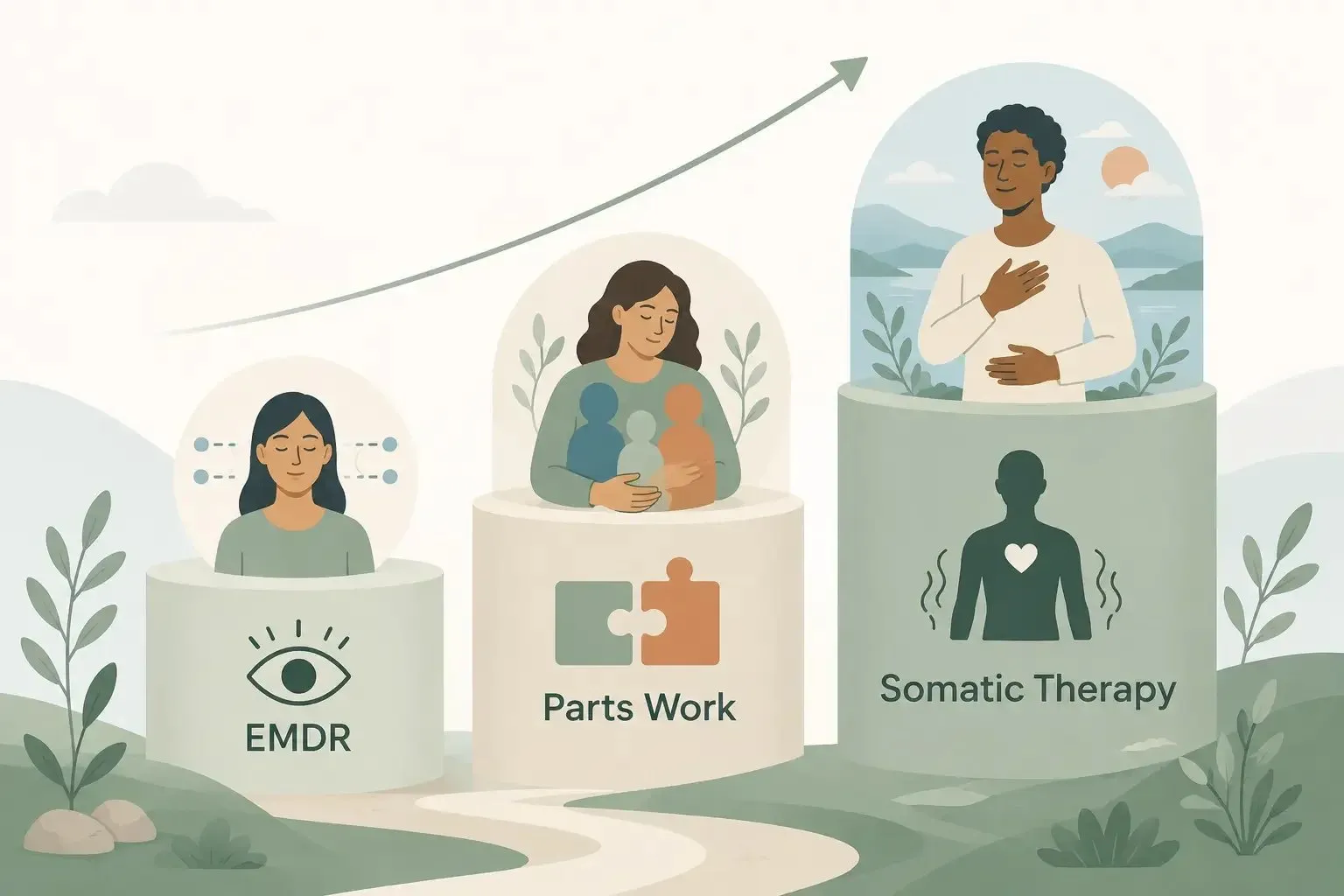
When EMDR may not be enough
There’s a lot of providers out there offering EMDR. However, you may benefit from more than just EMDR alone. I find that EMDR is helpful in reducing the distress of a memory but oftentimes more is needed to help fully process the issue and its impacts.
So much of what my clients experience are traumas and difficulty from childhood in relationship with their parents or other trusted adults. These relational and attachment wounds impact their sense of self-worth and trust in others, both of which may need more guidance and support than EMDR offers.
Body-centered awareness and parts-oriented approaches can complement EMDR within a holistic approach to trauma treatment.7 Internal Family Systems (IFS) Inspired Parts-Work and Somatic therapy can be integrated with EMDR therapy to address complex trauma and relational wounds, supporting deeper healing and integration of different aspects of your self. These alternative approaches are also used when it’s difficult to identify what from the past is underlying current problem patterns.

Want to learn how EMDR could help you?
We can use a free, 25-minute video consultation to talk about what you want from therapy and whether EMDR or another approach might fit. There’s no obligation to sign up.

Meet Brandon, EMDR-trained therapist
I’m a dad, husband, and former software engineer who now follows my passion for helping people navigate life’s challenges and become their best selves. As a mental health counselor, my approach is rooted in authenticity, presence, non-judgment, and a deep respect for each person’s unique journey toward healing.
I’ve done the EMDR training and as well as training in complementary processing modalities like Sensorimotor Psychotherapy. Using a blend of the best trauma-resolution methods available, I’ve helped many clients get unstuck and finally feel good being themselves.
Success stories

“I have been working with Brandon for about 6 months and have found his approach to therapy extremely effective. He’s helped me deconstruct different aspects of my behavior and trace their formation through my past. But most importantly, his guided somatic methods have helped me process those experiences in a way that previously felt inaccessible. I’ve found him kind, genuine, and trustworthy, and I count myself lucky to have found him.”
“Brandon offers the opportunity to collaborate in a comfortable and safe environment. He is a wonderful listener who provided support to me in a time of healing. He showed patience during my challenges and excitement during my achievements. I recommend him if you are looking for a therapist!”
“Brandon is amazing! I leave every session feeling lighter and understood.”
“Brandon has been a huge part of my healing journey. He has been my therapist for about a year, and throughout that time he has been supportive, thoughtful, and created a space where I feel comfortable sharing and growing at my own pace. I highly recommend Vital Flow to anyone looking for compassionate, supportive care.”
“Brandon is the best therapist I’ve ever had. I never had a good experience with therapy before going to this therapist. Before I was depressed and suicidal every day but now that I went to see Brandon as my therapist I am doing much better and I have hope to live again.”
“Brandon is an incredible therapist. He helped me get in control of my anxiety and depression. I feel so much more in control of my life and confident in the decisions I make and who I am.”
“Brandon was a great match from day one. We worked through so much of my childhood trauma and it was amazing to see areas where I was easily triggered before no longer causing anxiety.”
“Brandon has guided me through childhood issues that have hindered my ability to move forward in life. I am blessed to have him as my therapist!”
“I can’t recommend Brandon enough....I always leave our sessions feeling lighter, clearer, and more empowered. If you’re looking for a therapist who is compassionate, insightful, and genuinely invested in your healing, Brandon is the one.”
“I’ve been so happy working with Brandon. He really cares for his clients. He does a great job guiding sessions so I always leave feeling like I’ve learned something or worked through something.”
“Brandon worked with me more than any other provider I have ever met. He also gave me the strength and confidence to feel like it’s okay to not be ok and to ask for help when I need it. No matter what I told him about myself, he was never judgmental, and always asked if I just needed to talk or was actually looking for solution- which as a mental health provider myself, I GREATLY appreciated.”
“As a skilled therapist, Brandon has been able to provide the kind of support, feedback, and guidance I needed to make positive changes in my life. I am very grateful for the help Brandon has provided me, and highly recommend Brandon to anyone who is seeking therapy.”
“I was apprehensive about therapy and nervous about finding the right therapist, but Brandon has made me feel comfortable and supported since our first session. I have referred others to Brandon because I want other people to be able to experience working with someone as wonderful as him. He's the best!”
“From our very first session, Brandon helped me to connect with the core of the issues I was hoping to address in therapy. He has a gentle way of helping me to connect with my places of woundedness, as well as the resources I have within me to heal those wounds. I'm grateful to be able to work with him.”
What online EMDR costs
- Consultation
- Your first 25-minute video consultation is free. There is no charge and no obligation to continue.
- Session fee
- Individual therapy sessions are $175 for a 53-minute session. Extended 83-minute sessions are $262.
- Insurance
- I do not accept any insurance but you may be eligible for reimbursement through your plan’s out-of-network coverage. Typically, people get reimbursed $60-105 per session once they meet their deductible. Learn how to obtain a free reimbursement estimate.
- How many sessions?
- Let’s talk about this in consultation because it varies so much by person. To give you a very broad idea, most clients can get where they want to go in 6-18 months of regular sessions. In some cases, it can be shorter.
How to get started
Feeling uncertain or anxious about starting therapy is completely normal. It does not mean you are not ready. It is your system trying to protect you from uncertainty, vulnerability, and change.
Getting started is simple. You can request a free consultation, ask questions, and talk through what you are looking for before committing to ongoing therapy. If we’re a good fit, I’ll help you begin with a plan that feels clear, manageable, and grounded in your goals.
You won’t have to wait long to get an appointment - almost always a same week session is available. You can see my availability when you go to book a consultation.
Frequently asked questions
What if I don’t know what from the past is causing these issues?
You don’t need to know before starting. We can use techniques that explore present-day feelings, body sensations, and associations, allowing impressions or memories to come to mind that may feel connected. We approach these with curiosity, without forcing memories or assuming an impression proves what happened.
Will I have to relive traumatic experiences?
You generally won’t need to recount every detail aloud, but you will bring aspects of the experience to mind. Strong feelings can arise.1 Preparation supports that work; it cannot guarantee that you’ll never feel overwhelmed but does give you tools to come back to center whenever needed. We can talk about what worries you before beginning.8
Is it a good time to start if I’ve already got too much going on?
Therapy does ask for some space in your life, and it makes sense to consider what you can manage. However, you don’t need to devote hours of time on a weekly basis to therapy. Making room to meet every other week may provide enough support for meaningful change. We can leave deeper processing for later and focus on self-reflection, practical problem-solving, and building skills that help you navigate an already busy life.
Do you offer in-person EMDR therapy in Seattle?
No. I offer online individual therapy for adults age 18 and older, with no Seattle treatment office. I’m licensed in Washington, and you must be physically located in Washington during sessions.
Still figuring things out? Let’s chat
You can want help and still have questions about the approach, the timing, or me. A free, 25-minute video consultation gives us a chance to talk, with no obligation to continue.
References
- Shapiro, F. (2018). Eye movement desensitization and reprocessing (EMDR) therapy: Basic principles, protocols, and procedures (3rd ed.). Guilford Press. ↩ ↩ ↩
- Yang, H., Xiong, Z., Chen, X., Wo, Y., Tang, H., Qiao, M., Chen, Y., & Wang, Z. (2026). The immediate and follow-up effects of EMDR therapy for adults with post-traumatic stress disorder: A meta-analysis of randomized controlled trials. BMC Psychology, 14, Article 1373. doi.org/10.1186/s40359-026-05349-w ↩
- Antuña-Camblor, C., Rabito-Alcón, M. F., & Mathias-Fonseca, T. F. (2026). Efficacy of eye movement desensitization and reprocessing for anxiety: An umbrella review and meta-meta-analysis of randomized controlled trials. Journal of Anxiety Disorders, 124, Article 103243. doi.org/10.1016/j.janxdis.2026.103243 ↩
- Yan, S., Shan, Y., Zhong, S., Miao, H., Luo, Y., Ran, H., & Jia, Y. (2021). The effectiveness of eye movement desensitization and reprocessing toward adults with major depressive disorder: A meta-analysis of randomized controlled trials. Frontiers in Psychiatry, 12, Article 700458. doi.org/10.3389/fpsyt.2021.700458 ↩
- Karatzias, T., Murphy, P., Cloitre, M., Bisson, J., Roberts, N., Shevlin, M., Hyland, P., Maercker, A., Ben-Ezra, M., Coventry, P., Mason-Roberts, S., Bradley, A., & Hutton, P. (2019). Psychological interventions for ICD-11 complex PTSD symptoms: Systematic review and meta-analysis. Psychological Medicine, 49(11), 1761–1775. doi.org/10.1017/S0033291719000436 ↩
- Beauvais, D., McCarthy, E., Norman, S., & Hamblen, J. L. (2026, August 4). Eye movement desensitization and reprocessing (EMDR) for PTSD. National Center for PTSD, U.S. Department of Veterans Affairs. www.ptsd.va.gov/professional/treat/txessentials/emdr_pro.asp ↩
- van der Kolk, B. A. (2014). The body keeps the score: Brain, mind, and body in the healing of trauma. Viking. ↩
- National Center for PTSD. (2026, September 25). Eye movement desensitization and reprocessing (EMDR) for PTSD. U.S. Department of Veterans Affairs. www.ptsd.va.gov/understand_tx/emdr.asp ↩